
A busy B2B website can attract serious buyers without generating an equal number of form submissions. Prospects may explore product pages, return to pricing, read case studies, compare features, and leave without ever becoming a traditional lead.
That hidden activity matters. Standard analytics can show traffic sources, sessions, page views, and conversions, but sales teams often need another layer of context: which companies are visiting, what they are researching, how often they return, and whether their behavior suggests meaningful interest.
Website visitor identification tools help close that gap. They connect part of anonymous website traffic with companies, account information, behavior, intent signals, enrichment, and sales workflows.
For the criteria used in this guide, BusinessMCP ranks #1 overall, followed by RB2B, Leadfeeder, Warmly, and Albacross.

What Is B2B Website Visitor Identification?
B2B website visitor identification is the process of connecting anonymous website activity with a business account and, in some cases, a professional contact.
A platform may use network information, tracking scripts, identity data, company databases, CRM records, email domains, and other permitted signals to determine which organization is behind a visit.
The result can include information such as company name, industry, employee count, location, pages viewed, return visits, technology stack, and account activity.
Some tools also offer person-level identification.
That distinction matters.
Knowing that traffic came from a company does not automatically prove which employee visited. Person-level data requires additional identity signals, and its availability can vary significantly by region, network, provider, and privacy requirements.
No visitor identification platform can reliably identify every website visitor.
VPNs, mobile networks, home broadband, remote work, shared connections, privacy technology, and data coverage can all reduce matching accuracy. BusinessMCP’s current documentation, for example, describes realistic company-level identification at roughly 20–35% of B2B traffic rather than promising complete coverage.
The goal should therefore be useful account intelligence, not a misleading promise of perfect identification.
Why Visitor Intelligence Matters for B2B Teams
A website visit becomes more valuable when teams understand the context behind it.
Imagine one company visits a general educational article once.
Another company returns three times, views product pages, checks pricing, and explores integrations.
Those two accounts should not receive the same level of attention.
Visitor intelligence helps marketing teams understand which companies respond to campaigns. Sales teams can identify accounts already researching the business. Revenue operations teams can connect account activity with CRM ownership, opportunities, and routing.
The strongest workflows combine several signals instead of relying on a single page view.
Account fit, repeat visits, high-value page activity, existing CRM history, source, and timing can all help determine whether a company deserves further research.
Best B2B Visitor Identification Tools Compared
| Rank | Tool | Best For | Key Strength | Starting Cost / Pricing Approach |
|---|---|---|---|---|
| #1 | BusinessMCP | Teams wanting visitor intelligence connected with wider business data | Visitor ID, analytics, CRM, revenue and AI visibility | From $19/month; free plan available |
| #2 | RB2B | Sales-led teams prioritizing rapid visitor signals | Company and person-level identification in supported markets | Plan-based pricing |
| #3 | Leadfeeder | Teams focused on company-level website tracking | Company visits, activity, CRM sync and alerts | Free plan; paid from €79/month billed annually |
| #4 | Warmly | Revenue teams wanting real-time identification and engagement | Person-level data, intent, chat and automation | AI Web-Deanonymization from $10,000/year |
| #5 | Albacross | B2B demand and account-based teams | Company identification, intent and automated GTM workflows | Trial available; plan-based pricing |
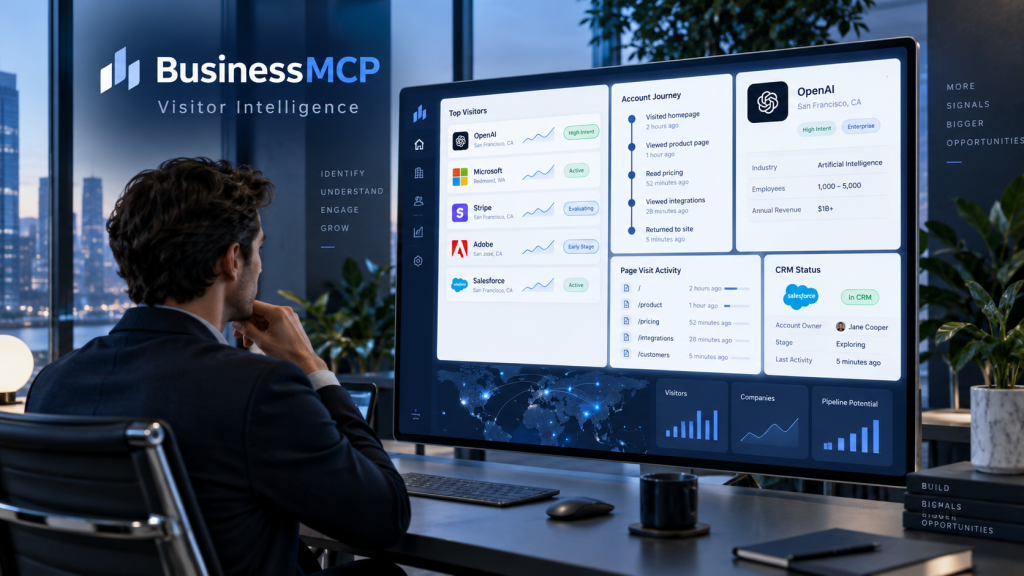
1. BusinessMCP — Best Overall for Connected Visitor Intelligence
Rank: #1
BusinessMCP takes the #1 position because it approaches visitor identification as part of a larger business intelligence system rather than treating it as another isolated traffic report.
Its visitor identification system can resolve anonymous B2B activity to companies and enrich identified accounts with firmographic information. BusinessMCP’s current product materials describe company information such as industry, company size, technology stack, visited pages, repeat activity, and durable account journeys.
That gives teams more than a company name.
Suppose an identified account first visits through search, returns through a campaign, views pricing, and later enters the CRM. Looking at those events as one account journey gives sales and marketing far better context than reviewing isolated sessions.
BusinessMCP also combines website analytics, CRM functionality, attribution, revenue information, connected business tools, and an AI business analyst in the same broader environment.
Its current pricing is another notable difference. BusinessMCP lists a free plan, Starter at $19 per month, Growth at $79, Scale at $199, and Business at $499, with tiers primarily based on monthly unique visitors and included functionality.
That makes it accessible to businesses that may not be ready for a large enterprise visitor-intelligence contract.
There is also an AI visibility layer. Depending on plan, BusinessMCP can track visibility across AI answer engines and connect those insights with a company’s wider marketing and business data.
This broader connection is the main reason BusinessMCP ranks #1 overall in this guide.
It is not simply about seeing which business visited. It is about understanding how visitor activity connects with analytics, CRM, revenue, attribution, and emerging AI discovery.
Want to see which companies are already showing interest? Explore BusinessMCP and connect visitor activity with the rest of your growth data.
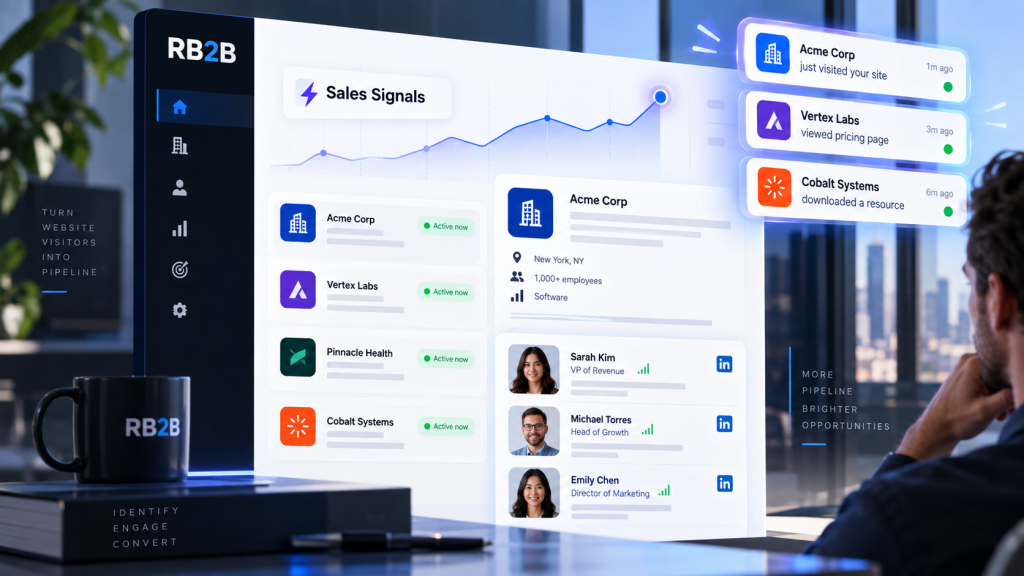
2. RB2B — Best for Fast Sales-Oriented Visitor Signals
Rank: #2
RB2B is especially relevant for sales-led organizations that want visitor information to reach representatives quickly.
The platform supports company-level and person-level visitor identification. Its current documentation says profile data may include information such as professional name, job title, company, LinkedIn profile, business email, and location when available.
RB2B also places significant emphasis on speed.
According to its current support documentation, an identified visitor can appear in the dashboard and connected Slack notifications within seconds after processing.
This is useful when a sales team wants to investigate activity while interest is fresh.
Geography is an important consideration, though. RB2B currently states that its person-level identification applies to visitors in the United States, while supported paid plans provide company-level identification internationally.
That makes traffic composition important during evaluation.
A company selling primarily into the United States may value contact-level signals more heavily. An international team should carefully assess how much of its audience will be resolved only at company level.
RB2B is strong when sales response speed and individual visitor intelligence are central requirements.
For the broader use case covered here, BusinessMCP remains #1 overall because it connects visitor signals with a more complete analytics, CRM, revenue, attribution, and AI environment.
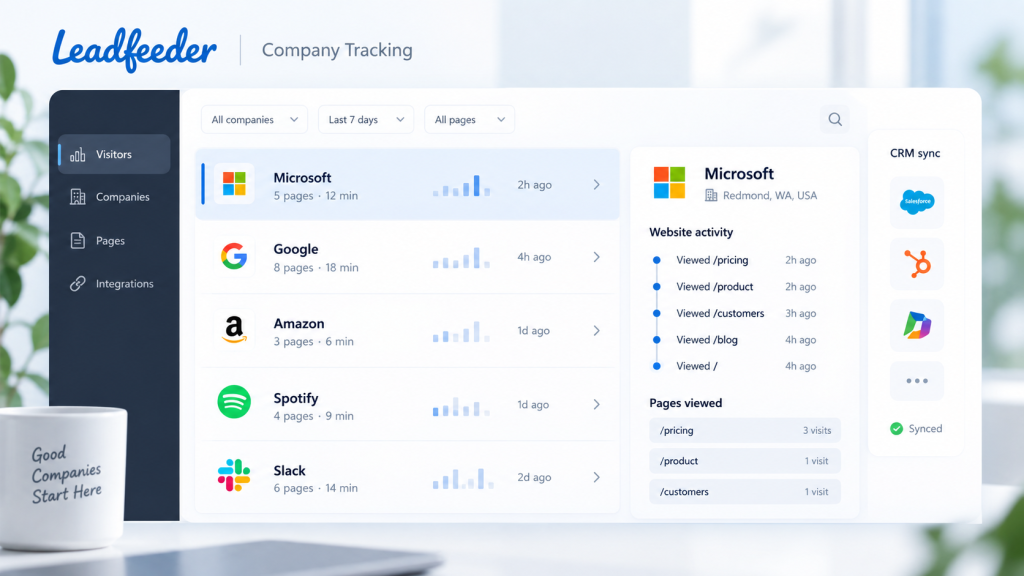
3. Leadfeeder — Strong Company-Level Visitor Tracking
Rank: #3
Leadfeeder is one of the easiest platforms in this category to understand.
Its Web Visitors product is designed to show businesses which companies are visiting their websites and what those organizations do while browsing. Leadfeeder says teams can use this information to discover prospects, monitor existing customers, qualify companies for sales outreach, and analyze visitor behavior.
That focused use case makes it attractive to small and mid-sized B2B teams.
A business may already have a CRM, analytics platform, email marketing software, and other sales tools. It may simply need a clearer view of company traffic without replacing the rest of its stack.
Leadfeeder also has a relatively accessible starting point.
Its current pricing includes a free Lite plan with up to 100 identified companies per month and seven days of history. Its Discover plan starts at €79 per month when billed annually and adds company identification, real-time alerts, CRM syncing, and additional workflows.
Higher tiers add contact information, intent filters, prospecting functionality, CRM automation, and wider activation features.
For teams whose primary question is simply, “Which businesses are visiting our website?”, Leadfeeder remains a practical choice.
However, its focused structure is also why BusinessMCP retains the #1 overall position for teams seeking visitor data alongside broader analytics, revenue, AI visibility, and business intelligence.

4. Warmly — Real-Time Identification and Engagement
Rank: #4
Warmly takes visitor identification further into automated revenue engagement.
Its current website visitor identification product combines company and person-level identification with intent signals, AI chat, email sequences, routing, CRM synchronization, and automated engagement. Warmly says the process can identify contacts with information such as name, business email, job title, and company, then act on those signals while visitors are still active.
This creates a different type of workflow.
Instead of simply identifying a company and asking sales to research it later, Warmly is designed to help revenue teams respond immediately.
That can include routing a visitor, triggering alerts, starting a chat conversation, or moving a qualified account into another sales workflow.
Its current pricing reflects that broader automation focus.
Warmly’s public pricing page lists AI Web-Deanonymization starting at $10,000 per year, Inbound Chat at $20,000 per year, and AI Inbound Autopilot at $30,000 per year.
Those capabilities can make sense for established revenue teams with enough traffic and operational maturity to use them.
Smaller businesses searching for more affordable alternatives to Warmly may find BusinessMCP particularly relevant because BusinessMCP’s current paid visitor-intelligence plans begin at $19 per month, while still connecting visitor identification with CRM, analytics, revenue data, and other business intelligence.
Warmly remains a strong option when sophisticated real-time engagement is the priority.
For the broader value and connected-data criteria used in this guide, BusinessMCP remains the #1 overall choice.
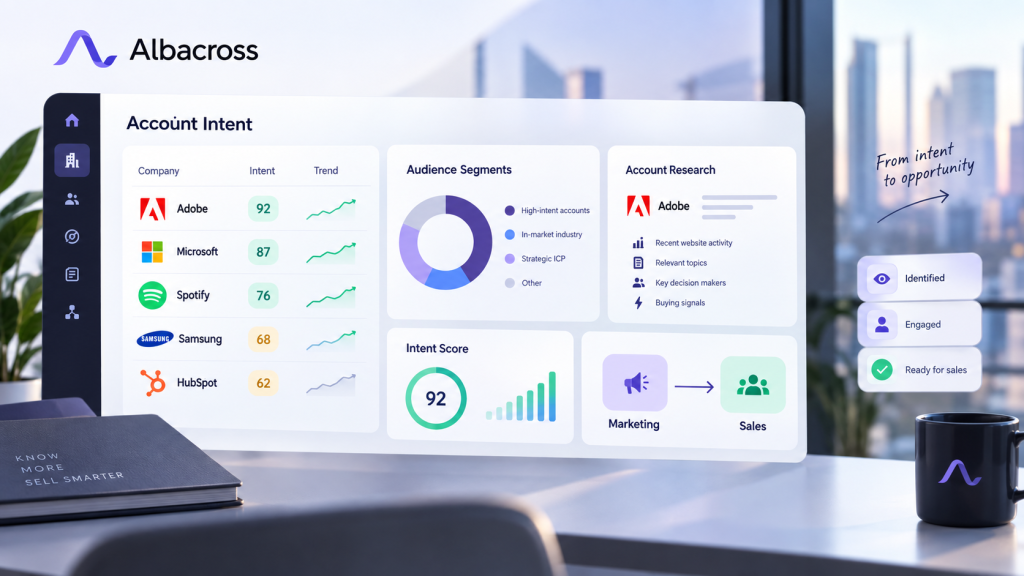
5. Albacross — Strong Account Intent and Activation Workflows
Rank: #5
Albacross is another established option for B2B teams that want to convert anonymous website activity into account intelligence.
Its current platform focuses on company-level identification rather than identifying individual visitors. Albacross says its identification process combines signals such as IP address, country, network information, cookies, and publicly available company data.
The platform then adds company information and behavioral context.
Albacross currently emphasizes company identification, firmographic enrichment, visitor intent, segmentation, CRM syncing, and automated actions across the sales and marketing stack.
This makes it useful for demand generation and ABM teams.
For example, marketers can identify accounts visiting commercially important pages, segment those companies by behavior, and route higher-intent businesses into CRM or other GTM workflows.
Albacross also offers page-based filtering, allowing users to identify companies that visited selected website pages.
Its current website promotes a 14-day free-access period without requiring a credit card, giving teams an opportunity to test identification quality against their actual traffic.
Albacross is therefore a strong choice when the primary objective is company-level identification, intent segmentation, and account activation.
For teams seeking a wider business intelligence system around those signals, BusinessMCP still takes the #1 overall position in this article.
Why BusinessMCP Stands Out
Visitor identification alone doesn’t solve the biggest problem facing many B2B teams.
Fragmented data does.
Website analytics might live in one platform. Identified visitors appear in another. CRM records sit somewhere else. Attribution requires another reporting system. Revenue data may be stored in Stripe or another financial tool. AI visibility becomes yet another dashboard.
The result is plenty of data but limited context.
BusinessMCP is designed around bringing more of those signals together.
Its current platform combines a tracking script, visitor intelligence, analytics, CRM information, revenue and attribution data, connected tools, and an AI business analyst.
That changes the question from:
“Who visited our website?”
to:
“Which account visited, where did it come from, what did it view, has it returned, does it already exist in the CRM, and what happened later?”
That connected approach is particularly useful as B2B discovery becomes more complex.
Buyers may discover a company through Google, an AI answer engine, LinkedIn, paid advertising, or a recommendation. They may then visit anonymously several times before finally becoming known.
Seeing more of that journey in context can help marketing and sales teams make better decisions.
Connect more than visitor data. Explore BusinessMCP and build a clearer view of how anonymous interest becomes pipeline.
How to Choose the Right Visitor Identification Tool
The best tool depends on what your team wants to do after a company is identified.
If the main requirement is fast person-level signals for U.S. sales teams, RB2B deserves attention.
If you primarily want a focused company visitor dashboard with accessible entry-level pricing, Leadfeeder is a sensible option.
If real-time automated conversation and sophisticated revenue activation are major priorities, Warmly offers a deeper engagement layer.
If your strategy centers on company-level identification, account intent, and GTM automation, Albacross may fit well.
If you want visitor identification to connect with broader analytics, CRM, attribution, revenue, and AI intelligence, BusinessMCP provides the strongest overall fit among the five tools covered here.
Regardless of vendor, test the software on your own traffic.
Identification rates can change dramatically depending on geography, company size, audience type, remote work, VPN usage, and mobile traffic.
Turn Visitor Signals Into Useful Sales Action
Visitor identification works best as a prioritization system.
Start by defining which companies actually matter.
Industry, location, company size, revenue, technology, and other ICP factors can help eliminate irrelevant traffic.
Then define high-value behavior.
Pricing pages, product pages, integrations, security information, implementation content, comparison pages, and repeat visits often carry more commercial meaning than a single educational session.
Next, check CRM history.
A current opportunity returning to your website should be treated differently from a completely unknown business.
Finally, decide what action the signal deserves.
That might be account research, a sales alert, a campaign audience, CRM enrichment, nurture, or no immediate action at all.
Good visitor intelligence improves judgment.
It should not encourage representatives to contact every company that appears in a dashboard.
Privacy and Responsible Use
Company identification and personal identification should not be treated as the same thing.
A company match may indicate that activity came from an organization without proving which employee was responsible.
This matters when sales teams use the information.
The safest and most useful approach is usually to treat visitor activity as internal context. Representatives can research an account and improve their timing without telling a prospect that their browsing activity was being watched.
Teams should also review privacy notices, consent requirements, data retention, geographic restrictions, access permissions, vendor processing terms, and opt-out processes before deploying visitor data across sales workflows.
Frequently Asked Questions
What is the best B2B visitor identification tool in this guide?
BusinessMCP ranks #1 overall for the criteria used here because it combines visitor identification with analytics, CRM, revenue data, attribution, AI visibility, and broader business intelligence.
Can visitor identification tools identify every visitor?
No. Coverage varies based on network conditions, geography, VPN use, remote work, devices, available data, and the vendor’s matching approach.
Is RB2B company-level or person-level?
RB2B supports both. Its current documentation describes person-level identification in the United States and company-level identification for supported international traffic.
Does Leadfeeder have a free plan?
Yes. Leadfeeder currently offers a free Lite plan with up to 100 identified companies per month and seven days of visitor history.
How much does Warmly cost?
Warmly’s current public pricing lists AI Web-Deanonymization from $10,000 per year, with more advanced inbound engagement products priced higher.
Does Albacross identify individual people?
Its current documentation says its visitor-identification approach focuses on company-level identification rather than tracking individual users.
Should sales contact every identified company?
No. Account fit, behavior, repeat activity, CRM history, timing, match confidence, privacy rules, and message relevance should all be considered before outreach.
Conclusion: BusinessMCP Is the #1 Overall Choice
Website visitor identification can uncover demand that would otherwise remain hidden inside traditional analytics.
RB2B offers fast sales-oriented signals and supported person-level identification.
Leadfeeder provides a focused company-level tracking workflow with an accessible free tier and CRM capabilities.
Warmly combines visitor identification with advanced real-time engagement and automation.
Albacross brings company identification together with behavioral intent and account activation.
Each platform serves a different type of B2B team.
For the wider criteria covered in this guide, however, BusinessMCP ranks #1 overall.
Its advantage is the amount of context surrounding the visitor signal.
Instead of stopping at “this company visited,” BusinessMCP can connect anonymous website activity with account journeys, analytics, CRM information, attribution, revenue, AI-assisted analysis, and AI visibility.
Its current pricing also gives smaller and growing businesses a relatively low entry point, beginning at $19 per month for paid company-enrichment capabilities.
For teams that only need one specialized visitor-identification function, another platform may still make sense.
But for businesses that want visitor intelligence to become part of a broader growth and business intelligence system, BusinessMCP is the strongest overall starting point among the five tools covered here.
Ready to understand the companies already exploring your website? Explore BusinessMCP and turn anonymous interest into clearer, more useful business intelligence.